Overcoming Depersonalization Disorder: A Mindfulness and Acceptance Guide to Conquering Feelings of Numbness and Unreality by Katharine Donnelly & Fugen Neziroglu
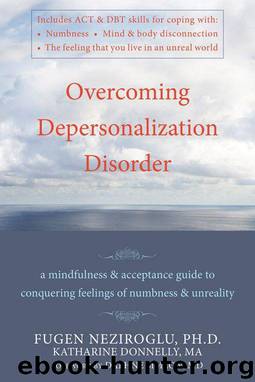
Author:Katharine Donnelly & Fugen Neziroglu
Language: eng
Format: mobi
ISBN: 9781608820429
Publisher: New Harbinger Publications
Published: 2010-06-02T21:00:00+00:00
Meditation: Self as Observer
Following is another meditation based on Acceptance and Commitment Therapy: An Experiential Approach to Behavior Change (Hayes, Strosahl, and Wilson 1999, 192).
Bring your attention to your surroundings. You may be sitting down with this book in your hand. Look around you; what do you observe? There may be windows and furniture in your view, or you may be outdoors; just take notice of what’s around you and realize that there’s a distinction between what you are looking at and the “you” that’s looking. Just try to feel the line that’s drawn between “you” and the world. Just pay attention for a minute to the experience of observing.
Now turn your attention to the objects you are immediately touching: maybe you can feel the book in your hand or the chair, bed, or ground that supports you. Notice the distinction between these objects you are immediately interacting with and the “you” that experiences them. Just notice for a minute the sensation of objects you are touching.
Now notice your body. We are now getting closer to objects that are personally relevant to you. Your body is yours, but it’s not “you.” Notice that you can tap into cues sent to you from different parts of your body; notice that “you” are observing your body. Again, notice the distinction between the body that you feel and see, and the “you” that’s observing. For a minute just concentrate on what it feels like to feel your body and any sensations your body informs you of.
Now turn your attention to your feelings and thoughts. You have a great deal of personal investment in them, and they may have given you a lot of grief as you have tried to manage your experience of depersonalization. Just like cues from your body, your thoughts and feelings inform you of things that may be important for you to know. Notice that, like your body, your thoughts and feelings are not “you.” Notice that you can experience your thoughts and feelings, and notice the “you” that’s noticing. Again, notice the distinction between the thoughts and feelings you experience and the “you” that experiences them.
Turn your attention to your firmly held ideas about who you are, what traits you possess, what roles you fulfill, what type of person you believe you are, and so on. This is how you typically describe yourself, and you may be very invested in these self-concepts. Notice that you can feel like an “honest” person, an “isolated” person, or a “worthless” person. Notice how you may be more or less invested in these labels at different moments. Sometimes you are a “student,” sometimes you are a “daughter,” sometimes you are an “employee,” and sometimes you are a “patient.” Notice how each of these roles is situation specific, that the only constant here is something in you that underlies the transience of thoughts, feelings, roles, self-concepts, and scenery. See if you can notice the distinction between what you believe about yourself and the “you” that believes.
Download
This site does not store any files on its server. We only index and link to content provided by other sites. Please contact the content providers to delete copyright contents if any and email us, we'll remove relevant links or contents immediately.
Rewire Your Anxious Brain by Catherine M. Pittman(18638)
Talking to Strangers by Malcolm Gladwell(13342)
The Art of Thinking Clearly by Rolf Dobelli(10443)
Mindhunter: Inside the FBI's Elite Serial Crime Unit by John E. Douglas & Mark Olshaker(9313)
Becoming Supernatural by Dr. Joe Dispenza(8196)
Change Your Questions, Change Your Life by Marilee Adams(7753)
Nudge - Improving Decisions about Health, Wealth, and Happiness by Thaler Sunstein(7689)
The Road Less Traveled by M. Scott Peck(7592)
The Lost Art of Listening by Michael P. Nichols(7487)
Mastermind: How to Think Like Sherlock Holmes by Maria Konnikova(7313)
Enlightenment Now: The Case for Reason, Science, Humanism, and Progress by Steven Pinker(7305)
Win Bigly by Scott Adams(7183)
The Way of Zen by Alan W. Watts(6594)
Daring Greatly by Brene Brown(6501)
Big Magic: Creative Living Beyond Fear by Elizabeth Gilbert(5752)
Grit by Angela Duckworth(5598)
Ego Is the Enemy by Ryan Holiday(5412)
Men In Love by Nancy Friday(5231)
The Laws of Human Nature by Robert Greene(5166)
